Seamless Gutter Installation
Custom-formed seamless gutters reduce leaks, look clean along your roofline, and handle water flow efficiently, and we fasten them securely with a proper slope toward the downspouts.

Service guide / San Diego
Plan gutters in San Diego: seamless aluminum vs. steel, sizing for winter storms, downspout placement, gutter guards for leaves and embers, and drainage.

Gutters in San Diego play a vital role in protecting your roof, siding, foundation, and landscaping from water damage.
Even though our rainfall is limited, heavy storms can overwhelm a home without proper drainage, causing erosion, staining, and costly structural problems. We install and repair seamless gutters and downspouts, carefully sloped and securely fastened so water flows away from your home. Our team can also replace damaged sections, fix leaks, and recommend guards that reduce clogs and maintenance. We offer durable materials and a variety of colors that blend with your trim and exterior. Every project is completed with precise measurements and neat, clean workmanship. We clean existing gutters and offer maintenance to prevent future clogs and overflow. If your gutters are sagging, leaking, or missing entirely, contact us today for a gutter installation or repair estimate in San Diego.
Custom-formed seamless gutters reduce leaks, look clean along your roofline, and handle water flow efficiently, and we fasten them securely with a proper slope toward the downspouts.
Well-placed downspouts and extensions carry water away from your foundation, preventing erosion, pooling, and soil damage that can threaten landscaping, walkways, and the structure of your home.
We fix sagging sections, loose hangers, leaking seams, and damaged corners, restoring proper function to your existing system without the cost of replacing everything when repairs will do.
When old gutters rust, crack, or pull away from the fascia, we remove them and install durable new systems in colors that blend with your trim and exterior.
Guards keep leaves and debris out of your gutters, reducing clogs and maintenance, and we install them carefully to allow water in while protecting your system during storms.
Routine cleaning removes debris, checks slopes, and tightens fasteners, preventing overflow and damage while extending the life of your gutters and protecting roof, siding, and foundation.
Where gutters help
Gutters collect roof water and send it where you choose. These are the situations that call for them.
A roof edge above a front door or patio slider keeps drips off people and keeps splash off the door base.
Controlled downspouts carry roof water past slope edges instead of letting it saturate the soil below.
Moving runoff away from slab edges reduces ponding at the footing, important in clay soils that swell.
Collected water can be piped to a dry well, bioswale or rain barrel rather than eroding mulch and paver joints.
Sagging runs, leaking seams and loose fascia fasteners are frequent fixes before a full replacement is needed.
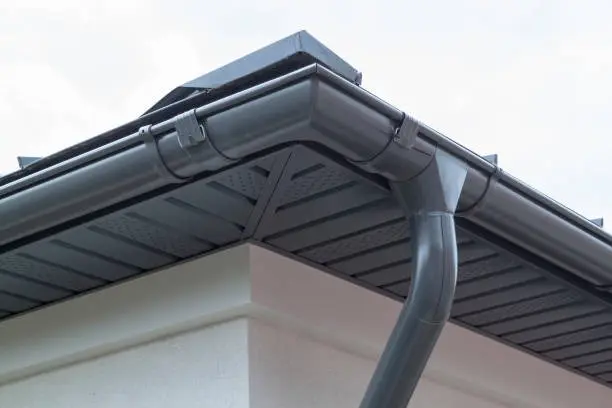

A single storm drops a lot of water on a roof in a short time, and the amount depends on roof area and pitch, not the size of the house footprint alone. Larger roof planes feed fewer gutters, which means wider gutters, more downspouts or both.
Sizing for a short, intense downpour rather than a typical light rain is what prevents overflow.
Material, shape and fastening decide how a gutter holds up in sun and salt.
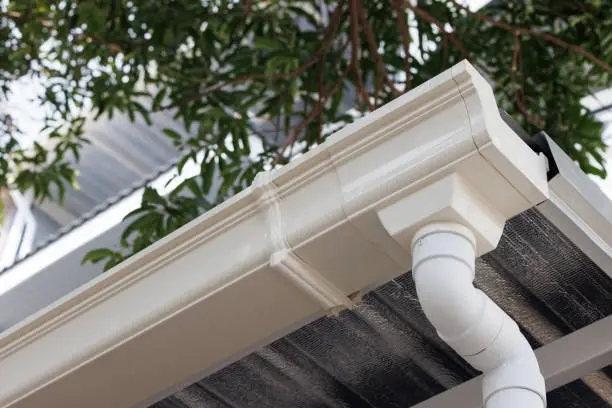
Formed on site from a roll so there are no seams along a run, and aluminum does not rust, which helps near the coast.
K-style hangs flat against fascia and carries more; half-round suits traditional or tile-roof styles but holds less per inch.
Wider gutters and larger downspouts handle storm bursts; a small gutter can overflow even when it is clean.
Hidden hangers set closely along the run keep gutters from sagging; fasteners must reach the rafter tails, not just the fascia board.
Baked-on finishes resist chalking; match fascia or trim color so the gutter disappears against stucco.
A slight, consistent slope toward the outlet keeps standing water and debris from collecting.
Debris control is a trade-off between cleaning frequency and how much water gets in.
Highest flow and simplest to inspect, but leaves, needles and seed pods settle inside.
Fine metal mesh blocks most debris and embers while letting water through.
Water follows the curved cover into the gutter while debris falls off; fine pollen may still collect.

Tile roofs with exposed rafter tails call for half-round or custom-profile gutters hung on straps, while flat stucco eaves and fascia boards take standard K-style runs.
Matching gutter color to trim or fascia, and routing downspouts down the least visible corner, helps the system blend into the wall.
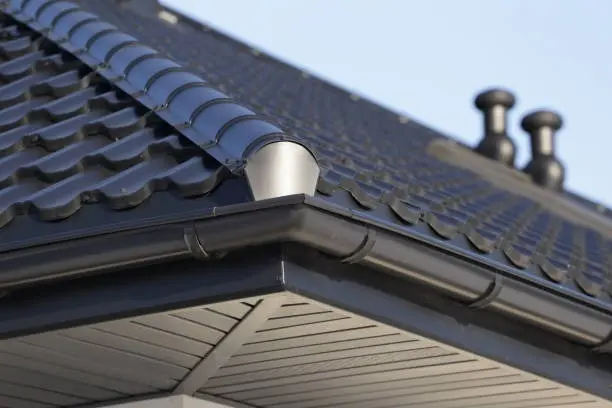
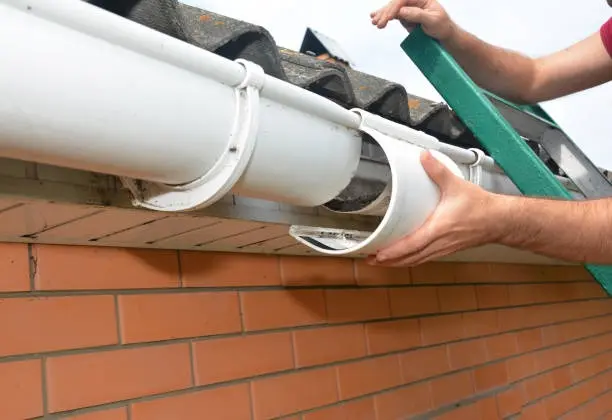
Note valleys, long runs, roof planes that drain into each other and any places water already overshoots.
Downspouts go at low points, away from entries, with a landing area that is paved, piped or planted for runoff.
Rotted fascia or loose rafter tails are repaired before gutters are hung, since they will not hold fasteners.
Seamless runs are cut to length, pitched, fastened and fitted with end caps, miters and outlets.
Downspouts get extensions or underground piping toward a safe discharge point, not against the foundation.
A hose test shows pitch, leaks and overflow points before the crew leaves, and again during the first real rain.
It depends on overhanging trees and guard type. Many owners clean before the wet season and after any big wind event, and check mid-season if leaves or flowers are dropping.
Noncombustible metal mesh guards can reduce embers collecting in the trough, but they are not a fire barrier. Keeping the roof and gutters clear of debris remains important.
Away from foundations, slopes and neighbors. Options include splash blocks, extensions onto landscaped areas, or buried pipe to a safe discharge, dry well or rain barrel. Check local drainage rules.
Yes, but the profile and hanger style matter. Straps or special brackets are used so the gutter does not interfere with tile overhang or crush the edge.
Standard gutters generally do not, but redirecting water to a public street, a neighbor's land or a slope may be regulated. Check with your city or County, and your HOA.
Usually a failed back flashing, sagging trough or a gap where gutter meets the drip edge. Water that runs behind the gutter can rot the fascia, so address it early.